In many companies the best answers to customers' questions are spoken. A specialist explains them in a live stream on social media (TikTok, Instagram), on the phone or at the customer's site, and then they are gone. A knowledge base chatbot built from those recordings keeps the answers and gives them to the next customer who asks, day and night.
This post grew out of a proposal we prepared for a supplier of farm equipment. Its specialists answer farmers' technical questions in live streams on social media and on the phone. What we proposed is an AI knowledge base built from those recordings, with a chatbot on top: in effect, an AI chatbot for farmers that knows what the company's specialists know. It is a design, not a finished project, so this post reports no results.
What a knowledge base chatbot is#
A knowledge base chatbot answers customers' questions from a company's own collected answers: its knowledge base. For each question it searches the knowledge base, finds the entries that fit, and writes its answer from them, with a link to where the answer came from. When nothing fits, a well-built chatbot says so and passes the question to a person. Whether it really does is one of the things a pilot has to test.
The work splits three ways. AI understands the question, weighs whether the knowledge base holds the answer, and chooses: answer, or hand over. Ordinary software keeps the entries with their sources and review dates, and applies the rules about which topics always go to a person. Complex questions stay with a specialist, who gets the conversation and the entries the AI found.
The model behind the chatbot is not retrained on your recordings. The recordings become the knowledge base it reads from, so a specialist can update an entry and the chatbot uses the new version. After a change it is still worth checking that the chatbot finds the updated entry and no longer relies on an older one.


Where the knowledge comes from: live streams and calls#
Most guides assume the knowledge is already written down as help articles. In a company that sells technical products, much of it is spoken. For an agribusiness, the sources could be:
- recorded live streams on social media, where specialists answer farmers' questions about nozzles, filters, pumps and how to set up the equipment;
- recordings of customer calls from the company's phone system;
- video consultations and training sessions;
- what is already written: catalogs, manuals and price lists.
A recording holds what a manual does not: the question in the customer's own words, and the answer the way a specialist gives it.
The approach has been tested in research. At EMNLP 2025, researchers at Dialpad described a system that extracts question-and-answer pairs from past customer calls to build a knowledge base. They tested it on calls from 20 companies and reported accuracy above 90%. Their system ran on a model fine-tuned on their own data, and in their design a knowledge manager can review the pairs before they are added. It is the result of one research system, not a promise for another chatbot.1
Call recordings need two cautions. First, they hold personal data: names, phone numbers, sometimes details of a farm. Callers should know that the call is recorded and what the recording is used for, and personal details are removed before anything reaches the knowledge base. The rules differ by country, so check them with a lawyer before using the recordings. Second, a call is not a lecture. Much of it is about prices, stock and delivery dates, which go out of date quickly and do not belong in a knowledge base.
From a recording to an answer: how it is built#
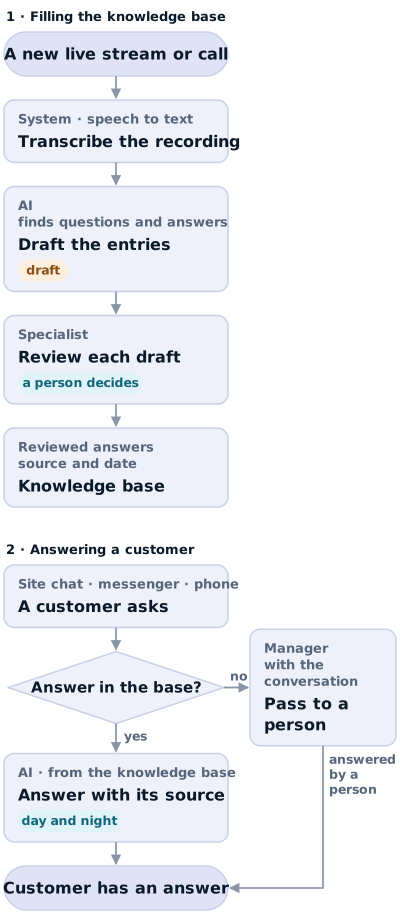
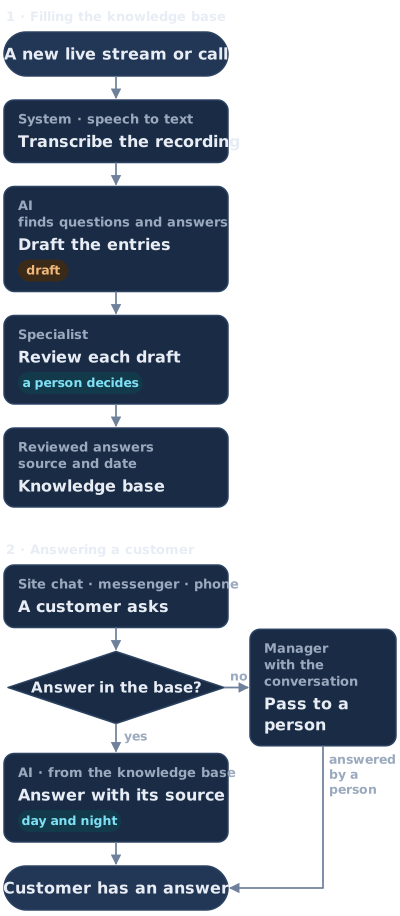
- Collect the recordings. Start with what exists: past live streams and the calls the phone system has kept.
- Transcribe them. Speech becomes text that shows who spoke and when, so every answer can be traced to the minute it was given.
- Draft the questions and answers. AI goes through each transcript, finds the questions customers asked and the specialist's answers, and writes each pair as a short draft entry. The drafts are grouped by topic: nozzles, filtration, pumps.
- A specialist reviews every draft, and approves it, corrects it or rejects it. A recording can hold a slip of the tongue, or advice that fits one farm only, and only a specialist can tell. The specialist also notes what the answer applies to: which equipment, under which conditions. Nothing unreviewed reaches a customer.
- Approved entries go into the knowledge base, each with its source and the date it was reviewed.
- The chatbot answers customers from the knowledge base.
- Keep it current. After each new live stream the system drafts new entries, and the specialist approves them the same way. When a new answer contradicts an old entry, the specialist decides which one stays.
We have built the first steps of this path before. On an agency's internal platform, a person uploads a call recording, and the system transcribes it with speakers and timestamps, splits the transcript into topics and writes a summary of each.
A sample knowledge base entry#
This is what one entry looks like. It is demonstration data: not a technical recommendation, and not taken from a client's knowledge base.
| Field | Example |
|---|---|
| Question | Which filter mesh fits an 03 nozzle? |
| Other ways customers ask it | "what strainer for 03 tips", "which filter do I put on an 03 nozzle" |
| Answer | For this maker's 03 nozzles, use a 50-mesh strainer. A finer mesh clogs sooner, and a coarser one lets through particles that can block the nozzle. For other sizes, see the maker's table |
| Applies to | Size 03 nozzles of the maker named in the live stream. Other makers and sizes need an entry of their own |
| Topic | Filtration |
| Source | Live stream of March 14, at 12:40 |
| Reviewed | By a specialist, on March 20 |
| Check again | When the product line changes |
| Who answers | The chatbot |
The "applies to" line matters as much as the answer. A specialist may recommend a filter for one nozzle on one farm, and that advice should not turn into a rule for every customer. The source and the review date make the answer checkable: a manager can open the recording at that minute and hear the original.
One knowledge base, several channels#
The same knowledge base can serve several channels.
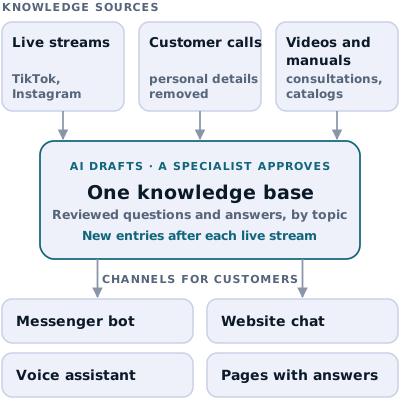
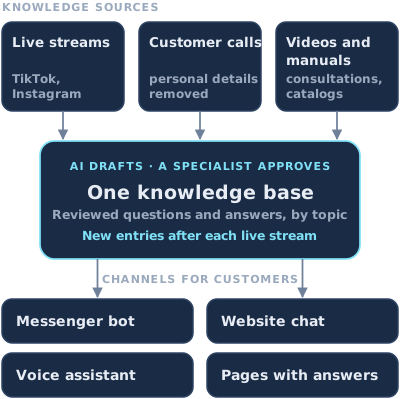
A farmer can get an answer in the evening, after the field work, when the managers have gone home. The bot works in the messenger customers already use, such as Telegram. The voice assistant is for a farmer who would rather call from the field than type. The pages with reviewed answers are also found through search.
We have built voice conversations and a Telegram bot before, for a different job. For AI Skills Space, a paid community, a voice agent talks with each new member and fills in their profile, and a Telegram bot checks the subscription and sends the invite to the group. A chatbot for farmers would use the same kinds of channel to answer from one knowledge base.
What a knowledge base chatbot should not do#
- Answer from anything but the knowledge base. When nothing fits, it says so and passes the question to a person, together with the conversation. The unanswered question goes on a list for the specialists, and that list shows what to cover in the next live stream.
- Answer where a mistake is costly. Topics such as warranty decisions, prices or chemical safety can be set to always go to a person.
- Quote prices or stock from an old recording. Those come from the catalog or the order system.
- Be treated as always right. Speech recognition can mishear a product name, and an old answer may no longer hold. The chatbot can also take an entry that only looks related for the answer, or join two entries into advice that neither of them gives. The specialist's review, the source beside each answer, the review date and the checks in the pilot are there for that.
AI for small business covers more of the habits that keep AI in check.
When a simpler option is enough#
- If a few dozen questions cover most of what customers ask, publish the reviewed answers as an FAQ page. That is the first half of this build, and it may be all you need.
- If your knowledge is already written as help articles, help desk software such as Intercom or Zendesk can answer from them without custom development.
- There is a middle path: transcribe the recordings with an off-the-shelf tool, write the answers up as help articles by hand, and let the help desk software answer from them.
- Custom work pays when the company needs its own process around the knowledge as well as a chatbot: recordings that arrive from the phone system by themselves, drafts for the specialists to approve, a review date on every answer, answers that draw on the company's catalog, and several channels on one knowledge base.
If most questions are about orders, deliveries and returns, that is a different system: AI customer service.
How to pilot a knowledge base chatbot#
Start small, and measure before opening it to customers:
- Take five to ten recordings of live streams or calls on the topics customers ask about most.
- Build the first knowledge base from them, with a specialist reviewing each entry.
- Collect a separate set of real customer questions for the test, a few dozen at least. Include vague ones, badly worded ones, and ones the knowledge base cannot answer.
- Put the chatbot in a private chat and run those questions through it. A specialist reads every answer.
Then count:
| What to count | What it shows |
|---|---|
| Questions answered from the knowledge base | How much of what customers ask the knowledge base already covers |
| Answers the specialist judged correct | How many of the answers a customer could act on |
| Wrong answers given with confidence | The costly kind: one wrong answer about which parts fit together can cost more than the other answers save |
| Questions rightly passed to a person | Whether the chatbot knows what it does not know |
| Sources that support the answer | Whether the link really backs what the chatbot said |
If the pilot holds up, the next stage opens one channel to customers, with hand-over to a person and new entries after each live stream. The voice assistant, the public pages and a report of what customers ask come after that.
The cost has two parts. Building covers the connection to the phone system, the screen where specialists review drafts, the link to the catalog, the chat itself, hand-over to a person, and testing. Running covers processing new recordings, AI usage for each answer, hosting, the specialists' review time and support. Plan the review time from the start: an entry nobody has reviewed should not reach a customer. How a first version like this is estimated is covered in MVP development cost.
Where to start#
If your specialists answer the same questions in live streams and on calls, start with a free 30-minute call. We will talk through what you have recorded, whether it is enough for a pilot, and what the pilot would cover.
Sources
-
Md Tahmid Rahman Laskar and others (Dialpad), "AI Knowledge Assist: An Automated Approach for the Creation of Knowledge Bases for Conversational AI Agents", Proceedings of EMNLP 2025: Industry Track, November 2025. https://aclanthology.org/2025.emnlp-industry.130/ ↩