
Solution · Legal · doctors’ disputes with insurers

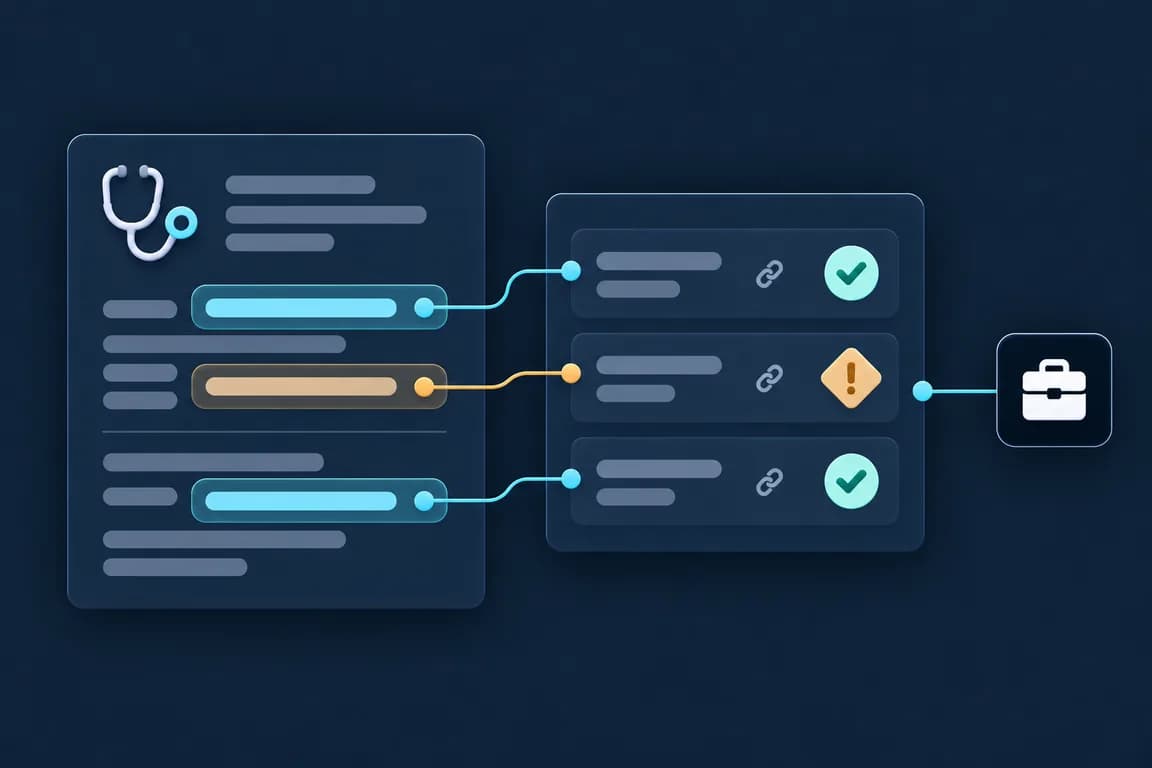
Each code on the bill checked against the medical chart automatically, with the insurer’s rule

We build this system to order for law firms that defend doctors when an insurer challenges a bill or asks for its money back. AI reads the patient’s medical chart, finds the words that back each service code (CPT) and the insurer’s own published rule for it, with a link, and weighs whether the chart backs the code. Ordinary software takes the charts and the bill and builds the report. The attorney decides which codes to defend

Who works with it

Attorney

Defends doctors in disputes with insurers

Gets a report for each chart: whether each code is backed, the words in the chart and the insurer’s rule with a link. Decides which codes to defend

Medical coder

A certified specialist in service codes, on the firm’s team

Gets the charts AI cannot read in full, and checks those parts by hand

Lead attorney

Runs the firm’s insurance disputes

Adds the firm’s own documents to the knowledge base the review uses. Sees the summary for each case: which codes are backed and which are not

What comes in

What the system reads for each chart, and what it gives the attorney

Medical chartsPDF, Word, scansThe billthe codes billedInsurer rulespublished, by regionKnowledge basethe firm’s documentsCase filethe insurer’s letterThe reviewreads, changes nothingReports with sourcesfor each chart and the caseAIAIAIMedical chartsPDF, Word, scansThe billthe codes billedInsurer rulespublished, by regionKnowledge basethe firm’s documentsCase filethe insurer’s letterThe reviewreads, changes nothingReports with sourcesfor each chart and the caseAIAIAI
Three ways out

The path of one chart

Chart and billfrom the case file
AIThe reviewrules and AI
  1. The chart backs the codesa report with sourcesa person decides
  2. A coder checksAI cannot read a parta person decides
  3. A code not backedthe chart backs lessa person decides
Example charts

Pick a chart and see what backs each code

Made-up patients and visits. The visit times are the published minimums for office visits; the rest stands for an insurer’s rules

Pick an example chart

A follow-up visit billed at the highest level

The codes on the bill AI
  1. 99215Established patient visit, highest levelBacks a lower code

    In the chart: “25 minutes”

    The insurer’s rule: billed by time, at least 40 minutes; 99213 needs at least 20 Medicare, guidance for the region

    By time the chart backs 99213, and the condition is stable. A higher level could only rest on the complexity of the decisions, which the attorney weighs

    The chart backs: 99213

What the attorney gets AIA code not backed

The attorney sees which code the chart backs and which it does not, with the sources, and decides what to defend

the attorney decides

Software, AI and a person

Who does which part of the work

Software and AI go through every chart. The attorney decides on every code

Rule

Ordinary software

Monotonous work with clear rules

  • Takes charts as PDF, Word files or scans, with no link to the clinic’s systems
  • Reads the codes from the bill and keeps each with its chart
  • Compares the time in the chart with the minimum each code needs
  • Builds a report for each chart and a summary for the case, with every source
  • Keeps the firm’s own documents in the knowledge base the review uses
AI

AI: understand, weigh and choose

The small decisions on every chart

  • Reads the chart, scans included, and finds the words behind each code
  • Finds the insurer’s published rule for the code and the region, with a link
  • Weighs whether the chart backs the code, a lower one or none
  • Names the code the chart does back
  • Says when it cannot read part of the chart, and does not guess
a person decides

A person

Every code that is defended

  • The attorney decides which codes to defend
  • The attorney checks each source before it goes into a filing
  • A coder checks every part AI cannot read
  • Only a person writes to the insurer or the court
  • The lead attorney adds the firm’s documents to the knowledge base
How a project starts

Four stages. After each one, you decide whether to go on

First on closed cases, then on new ones

  1. Usually firstDiscovery and specification
    In
    Your typical cases, the insurers and Medicare regions you face, and the codes that come up most
    You get
    A written specification: which cases come first, what the system needs, what it will cost and in what order. The document is yours whether or not we build it
  2. ThenTest on closed cases
    In
    Charts from closed cases, with patients’ names removed
    You get
    What the system found in each chart, next to what your team found
  3. ThenPilot with a few attorneys
    In
    New cases of a few attorneys you choose
    You get
    A report for each chart. The attorney checks every source while the rules are being set
  4. When you decideRollout
    In
    The case types you choose
    You get
    Every chart in those cases goes through the review. Your team adds to the knowledge base
Six questions we ask first
  1. How many medical charts do you review a month? We plan the system and the pilot around it
  2. Which cases come most: Medicare, commercial insurers, malpractice? The pilot starts with one of them
  3. Which insurers do you face most often? Their published rules are loaded first
  4. How long does one chart take your team today? The pilot is measured against it
  5. What share of charts are scans or handwritten? It shows how much text has to be read from images
  6. Do you keep the firm’s own documents on codes and insurers? They go into the knowledge base the review uses
In our cases

What we have built for a client

This system, built for one attorney as the first version of an online service

Tell us how your firm reviews medical charts today

A 30-minute call. We will say what your cases allow and where a project would start